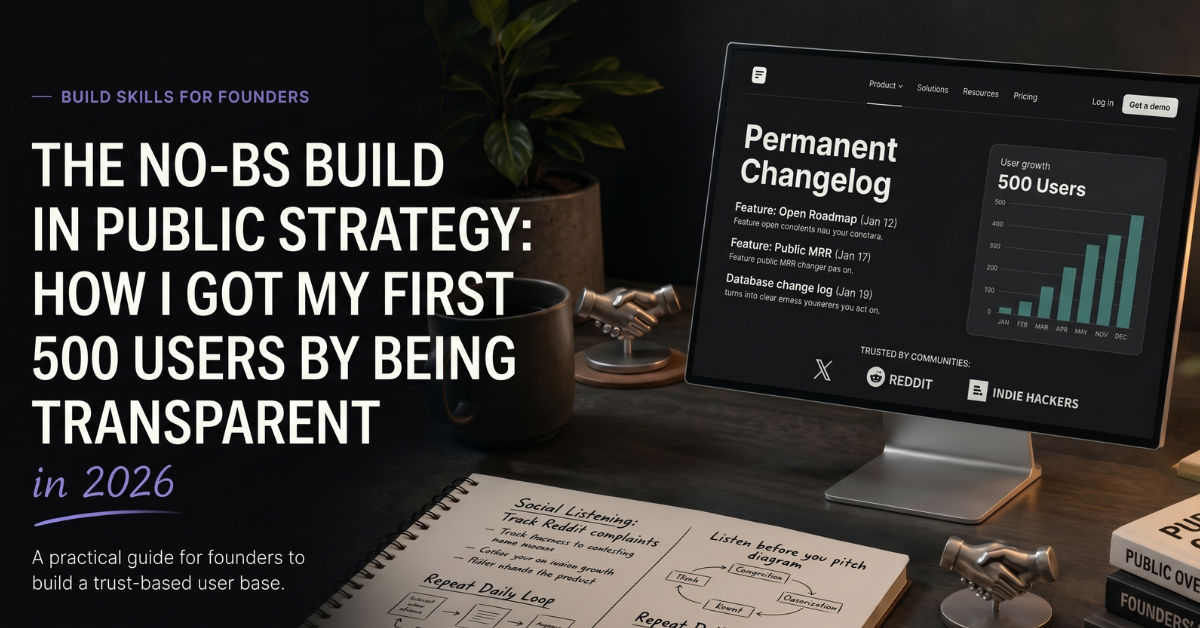
You post. Nothing happens. You post again. Still nothing. After a week of this, it's tempting to conclude that build in public only works for people who already have an audience, or who got lucky with the algorithm.
That's the myth. People look at founders pulling in early adopters from X or Reddit and chalk it all up to luck. They think building in public is a lottery ticket: you post a screenshot of your codebase, drop a link, and pray it goes viral. If a post does well, it was luck. If it bombs, the platform is dead.
But treating transparency like a game of chance is exactly why most developers are struggling to get eyes on their work.
A build in public strategy isn't luck. It's a repeatable skill, and like most skills, you can be bad at it before you're good at it.
When I launched my first product, it was an absolute grind. It took me more than three months just to scrape together my first 500 users. I felt like I was completely at the mercy of the feed. When I launched my second product, I hit that exact same 500-user milestone in less than a month.
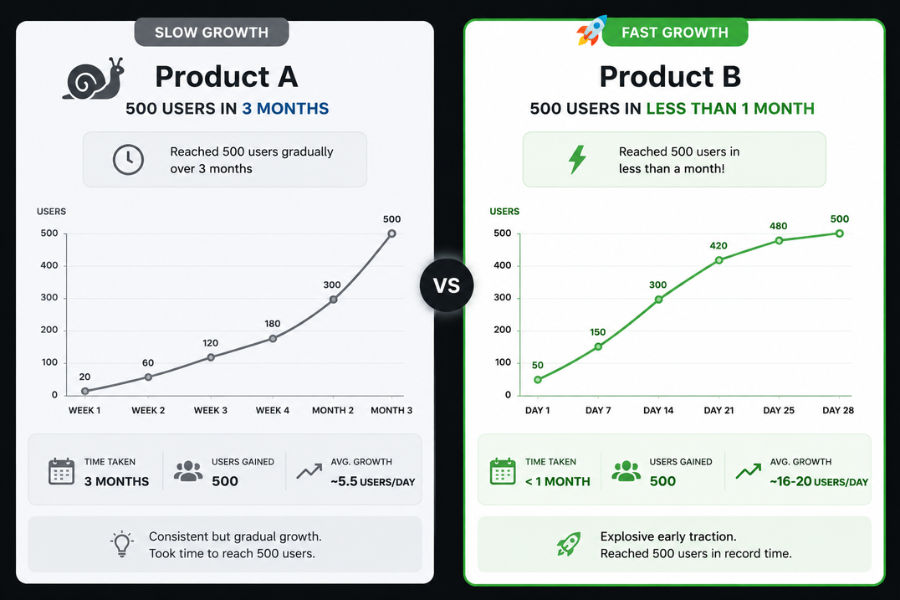
The market didn't change. My posts didn't suddenly get blessed by the algorithm. I recognized the mistakes I made the first time, fixed them, and treated building in public like an engineering problem that could be solved.
If you're tired of generic "just tweet your MRR" advice, here's the exact, unvarnished system I used to turn daily development struggles into real user acquisition.
What Is a Build in Public Strategy (And Why Most Fail)
A build in public strategy means sharing the real process of building a company: the bugs, the design decisions, the failed experiments, the small wins, instead of just announcing a finished product. Done well, it turns your daily progress into a steady stream of trust-building content and lets potential users watch a real founder solve a real problem before they're ever asked to buy anything.
Most build in public strategies fail for one of three reasons:
- No system. People post when they feel like it, so momentum dies the first busy week.
- No substance. Posts are AI-generated filler dressed up as "transparency."
- No permanence. Every update lives and dies on a single feed, so a week's worth of proof disappears the moment the algorithm moves on.
Fix those three things and build in public stops being a gamble. That's what the rest of this guide walks through.
The First Mistake: The "Illusion of Marketing"
When I was pushing my first product, I fell into a trap that almost every developer hits: I wanted the feeling of marketing without doing the actual work of marketing.
My strategy was embarrassing. I'd ask ChatGPT to write a tweet, copy-paste it, and hit publish. I cared less about what the post meant and more about tricking my own brain into thinking, "Look, I posted today. I am actively promoting my product."
I was optimizing for post count, not connection. The results were brutal.
Today, a single authentic post gets me a solid baseline of impressions and real engagement. Back then, it took 10 separate posts to scrape together that same reach. Worse, flooding my own feed with generic AI output tanked my account's reputation and dragged my product's visibility down with it.
Looking back at those three months, I was systematically sabotaging my own launch by doing five things:
- Copy-pasting GPT without my own ideas. People on X and Reddit can spot a ChatGPT hook from a mile away ("🚀 Exciting news, everyone!"). Zero personality, zero developer insight, zero reason for early adopters to care about me as a founder.
- Adding links directly in the post. I didn't understand the platform mechanics. Social algorithms penalize outbound links because they want to keep users on their app. I was killing my own reach the second I hit "post."
- Leading with a promotional tone. Every update screamed "please look at my app" instead of "here's a frustrating problem I just hit, and here's the exact code I wrote to get past it."
- Chasing quantity over quality. I ignored what I was actually saying, assuming that enough volume would eventually get rewarded. It didn't.
- Ghosting the actual community. I treated social media like a megaphone instead of a conversation. I never searched for threads where people were already complaining about the problem my product solved. I just broadcasted into the void.
I was acting like a spam bot and genuinely confused why real people weren't converting into users.
The 30-Day Pivot: Documenting Instead of Performing
When I launched my second product, I threw out the old playbook. I didn't entirely dump ChatGPT for writing posts, but instead, the ideas were mine and the enhancements I am doing sometimes with GPT.
Instead of manufacturing a marketing campaign, I treated user acquisition like an engineering problem. I needed to build trust. Here's how I hit 500 users in under a month.
1. Stop Shouting, Start Listening
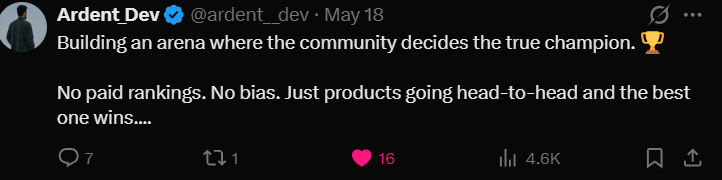
On X, I started sharing the raw, ugly reality of building: the database architectures that failed, the exact code I wrote to fix them.
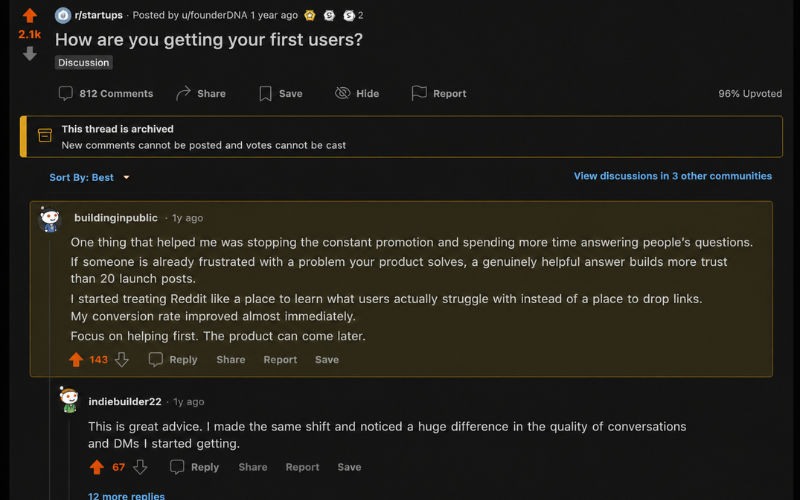
On Reddit, I changed my approach completely. Redditors will destroy you if they smell an advertisement. Instead of posting promotionally, I leaned into social listening. I tracked down conversations where people were actively complaining about the problem my app solved, answered their questions, shared technical insight, and only mentioned my product when it was the literal answer to their specific pain point.
2. The Ephemerality Problem
This approach was working. Users were trickling in. But I ran into a real flaw in the X and Reddit ecosystems: they have a brutally short shelf life.
I'd spend an hour writing a detailed thread or an in-depth comment. It would get great engagement for 48 hours, then disappear into the algorithm forever. When cold traffic landed on my profile or website a week later, none of that momentum was visible. All the work and community validation was invisible.
3. Anchor Your Journey Somewhere Permanent
This is the part of any build in public strategy that most people skip: a single source of truth. A public changelog and timeline that doesn't vanish when the feed refreshes.
You don't need to build this yourself. A few tools exist specifically for logging startup milestones in one permanent place.
What to Actually Post: The Content Blueprint
Your content needs to adapt based on where you are in the build. What works on day one won't work on day thirty. It comes down to two phases: before launch and after launch.
Before Launch: Sell the Pain
Before your app is even finished, talk about the exact pain point that made you start coding. I started my second product because I hated how boring standard product launches felt. I knew thousands of other founders shared that exact frustration. A shared, specific frustration is the hook.
During this phase, keep a clean waitlist page live. Your only goal is to collect emails from people who feel that problem right now.
When you share progress on X and Reddit, read the room. If you're a new Reddit account, give off zero promotional signal. Spend this whole phase building karma by being genuinely useful. Once your MVP works, stop overthinking it and push it live.
After Launch: The Smart Outreach Shift
Once the product is live, keep the same posting momentum, but widen the focus. Participate in threads started by other people. Try direct cold outreach on X to find early testers.
On Reddit, this is where your early karma finally pays off. You can start promoting a little, but carefully. Target the exact pain point without sounding like an ad. If you promote aggressively, Redditors will tear you apart in the comments, assuming the platform doesn't shadowban you first. Drop your link only when it's the natural answer to a specific complaint.
Beyond X and Reddit: Where Else This Strategy Works
X and Reddit are where I personally built my traction, but the same documenting-not-performing approach transfers to other channels:
- LinkedIn rewards founder-story posts in a similar way to X, especially for B2B products. The audience skews toward decision-makers rather than early adopters, so the tone can lean slightly more polished.
- Indie Hackers is built entirely around build in public milestones, so a cross-post of your permanent log fits natively without feeling promotional.
- YouTube or TikTok devlogs turn the same daily log into a visual, ephemeral-resistant format. A 60-second "what I shipped today" video can outlast a tweet by months in search.
- Product Hunt is less about daily updates and more about cashing in the trust you built everywhere else on launch day.
The platform changes. The underlying build in public strategy does not: log it permanently, broadcast it raw, engage where the pain already lives.
The 15-Minute Daily System
The biggest reason developers give up on marketing is thinking it requires four hours a day of content creation. It doesn't. It requires a system.
When you're deep in a backend bug or a hydration error, the last thing you want is to write a blog post. So keep it lean. Here's the loop, broken into three five-minute blocks:
- Minutes 1 to 5: The permanent log. Log the single most important thing you did today, in a timeline tool. Doesn't need to be a feature launch. Fixed an annoying bug, finalized dark mode, whatever. This secures your proof of work permanently.
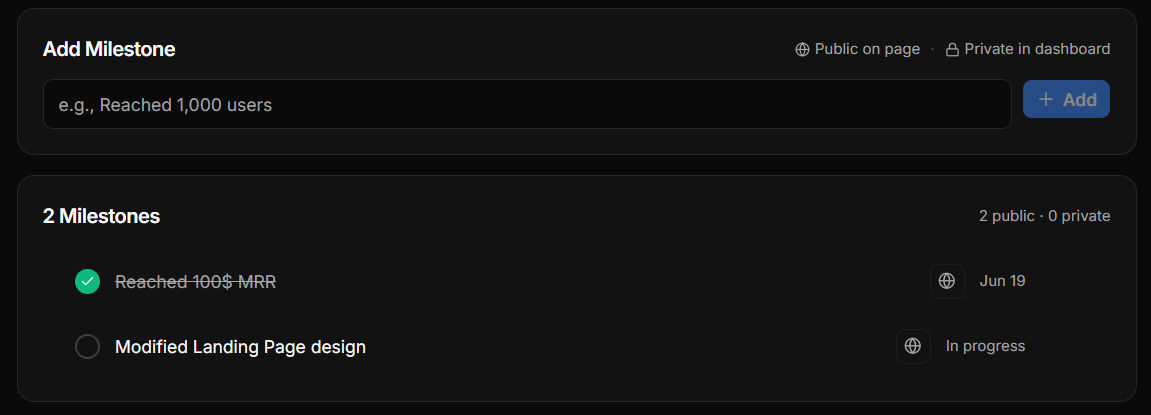
- Minutes 6 to 10: The raw broadcast. Turn that log into a short X post. Type the problem, how you solved it, maybe a screenshot. Publish and walk away.
- Minutes 11 to 15: The high-intent search. Go to Reddit. Don't scroll your feed, search for conversations where people are frustrated with the exact problem your product solves. Find one thread, leave one genuinely useful comment. Don't pitch unless it's the perfect answer.
That's the whole loop. Fifteen minutes.
Build in Public Strategy: The 4-Step Recap
If you only remember one section, make it this one:
- Log permanently first. Before you post anywhere, write the day's progress in a timeline that won't disappear in 48 hours.
- Broadcast raw, not polished. Skip the AI-generated press-release tone. Post the real problem and the real fix.
- Listen before you pitch. Find existing conversations about the pain point you solve. Help first. Mention your product only when it's the obvious answer.
- Repeat daily, not occasionally. Consistency beats virality. Fifteen minutes a day for thirty days outperforms one four-hour post.
Do this daily and you stop relying on luck or the algorithm. You build a searchable, permanent trail of proof. When cold traffic finally lands on your site, they won't find an empty shell of a product: they'll find a dedicated founder, a living timeline, and a tool they can trust.
If you've been waiting for the "right" big announcement to start posting, that's the wrong instinct. Log today's small thing, post it raw, and go find one thread to help someone in. Do that tomorrow too.
A note on tools: for the permanent log step, I have tried BuildTrail and it is pretty awesome. Readers can definitely use that if they want to frame things.
Frequently Asked Questions
A build in public strategy means sharing the real, unfiltered process of building a company: the bugs, design decisions, failed experiments, and small wins ; instead of only announcing a finished product. It turns daily progress into trust-building content that lets potential users watch a founder solve a real problem before being asked to buy anything.
Most fail for three reasons: no system (posting only when motivated, so momentum dies during a busy week), no substance (AI-generated filler dressed up as transparency), and no permanence (updates live and die on a single feed, so proof of progress disappears once the algorithm moves on).
About 15 minutes, broken into three 5-minute blocks: logging the day's progress somewhere permanent, turning that log into a short, raw post on X, and spending five minutes searching Reddit for one relevant conversation to genuinely help with : not pitch
No. Outbound links in posts get penalized by social algorithms because platforms want to keep users on-app, and dropping a link too early (especially on Reddit) reads as promotional and invites backlash. Links should only appear when they're the natural, specific answer to a problem someone is already discussing
Featured on ProductArena
The products mentioned in this article are quality, early-stage products featured on ProductArena. We highlight promising tools while they're still in their early days, so you can be among the first to discover and use them.